


A journey through 35000 years of rulers & civilizations


Here, at the edge of the abyss, the echoes of the first footsteps fade into the frozen dust of the Mammoth Steppe. From the ivory hearths of the open plains to the iron thrones of the empires, we have walked the path of the giants who built our world. We are the inheritors of their fire, their salt, and their stone.
The journey ends at the true beginning—where the earliest known open-air settlements were engineered, and humanity began to leave the nomadic life of the dark caves to build a world under the stars.

5500 BC


6500 BC
6000 BC
7500 BC
7000 BC
8500 BC
8000 BC

9500 BC
9000 BC
12500 BC
10000 BC


Settlements of Nazlet Khater
(Egypt),
The First Industrial Miners,
cca. 33000 BC


Settlement of Parța(Romania (Timiș),
Vinča-Turdaș Culture, cca.5600 – 5200 BC

Settlement of Tărtăria (Romania, Alba),
Vinča-Turdaș Culture, cca.5500 – 5300 BC

Town of Solnitsata (Bulgaria),
Provadia Culture,
cca.5600 – 5500 BC

Settlement of Vinča-Belo Brdo (Serbia, Danube),
Vinča Culture,
cca.5700 BC

Settlement of Sesklo (Greece, Thessaly),
Sesklo Culture,
cca. 6500- 5500 BC

Settlement of Vršnik (N. Macedonia),
Anzabegovo Culture,
cca.5800 - 5600 BC

Town of Çatalhöyük
(Anatolia, Turkey),
cca.7000 - 5700 BC

Settlement of Karanovo
(Bulgaria),
Karanovo Culture, cca.5900 – 5800 BC

Settlement of Hacılar
(southwestern Turkey),
cca.6000 BC
.jpg)
Settlements of the Iron gates
(Serbia & Romania),
Iron gates Culture,
cca. 9500 - 6300 BC

Settlement of Khirokitia
(Cyprus), Aceramic Neolithic
cca.7000 - 6800 BC

Settlement of Knossos
(Crete), Aceramic Neolithic
cca.7000 BC

City of Jericho,
(Palestine), Pre-Pottery Neolithic
cca.8500 - 7500 BC

Settlements of Mureybet
(Syria),
Natufian Culture,
cca. 10000 - 9200 BC

Settlements of Wadi Kubbaniya
(Egypt),
The First Nile Dwellers,
cca. 18000 BC

Settlements of Mezhyrich
(Ukraine),
Mammoth Bone Houses,
cca.15000 BC

Settlements of Tell Abu Hureyra
(Syria),
Culture of Natufian,
cca. 11300 – 11000 BC

Settlement of Göbekli Tepe,
(Turkey), Culture of Natufian
cca.10000 - 9500 BC

Settlements of Hallan Çemi
(Turkey),
cca. 10500 BC

Settlements of Eynan (Ain Mallaha)
(Israel),
Natufian culture,
cca. 12000 BC

Settlement of Netiv HaGdud
(Jordan), PPNA,
cca.8500 - 8200 BC
Settlement of Zawi Chemi
(Iraq), Shanidar culture,
cca.9000 - 8500 BC

Settlement of Nahal Oren
(Israel), Natufian culture,
cca.9000 - 8000 BC
_Tappeh_Sarab%2C_Kermanshah_ca__7000-6100_BCE_Neolith.jpg)
Settlement of Ganj Dareh
(Iran), Zagros culture,
cca.8000 - 7500 BC

Settlements of ell Qaramel
(Syria),
cca. 9500 - 8500 BC

Settlement of Franchthi
(Greece), Mesolithic Greece,
cca.8000 - 7500 BC

Settlement of Çayönü Tepesi
(Turkey), Taurus Neolithic,
cca.8200 - 7200 BC

Settlement of Ain Ghazal
(Jordan), PPNB culture,
cca.8000 - 7200 BC

Settlement of Tell Halula
(Syria), Pre-Pottery Neolithic,
cca.8000 - 7500 BC

Settlement of Aşıklı Höyük
(Turkey), Central Anatolian,
cca.8200 - 7400 BC

Settlement of Jarmo
(Iraq), Zagros Neolithic,
cca.7000 BC
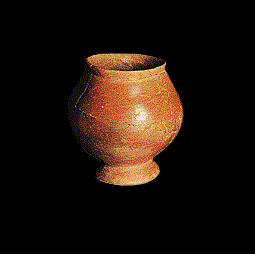
Settlement of Argissa Magoula (Greece, Thessaly),
Pre-Ceramic Neolithic,
cca. 6800- 6500 BC
15000 BC
17500 BC
20000 BC
22500 BC
25000 BC
27500 BC
30000 BC

Settlements of Pavlov VI
(Czech Rep.),
the regional first known Weavers,
cca. 30500 BC

Settlements of Kostyonki
(Russia),
the regional first known "Cold-Storage",
cca. 28000 BC

Settlements of Sunghir
(Russia),
the regional first known "Aristocracy",
cca. 28500 BC

Settlements of Grubgraben
(Austria),
the regional first known "Aristocracy",
cca. 27500 BC

Settlements of Dolní Věstonice
(Czech Rep.),
the regional first known Kiln,
cca. 31000 BC

Settlements of Krems-Wachtberg (Austria),
earliest known evidence in the region of a burial specifically integrated into a living floor,
cca. 27000 BC

Settlements of Willendorf II
(Austria),
earliest regional evidence of high-distance stone transport,
cca. 30000 BC

Settlements of Mezin (Ukraine),
earliest known evidence in the region of a musical percussion instruments
cca. 22000 BC

Settlements of Zaraisk (Russia),
known for its sophisticated "basement" storage technology
cca. 22000 - 20000 BC

Settlements of Abri Pataud (France),
large-scale thermal engineering (using stones as heat-storage batteries)
cca. 22000 BC

Settlements of Ohalo II
(Israel),
Earliest global evidence of wild grain processing in an open-air hut
cca. 19400 BC

Settlements of Gönnersdorf (Germany),
The Slate Library
cca. 15500 BC

Settlements of
Cuina Turcului ( Romania),
earliest known evidence in the Balkans of a "Riverine Industry,"
cca.12500 BC

%2C%20in%20the%20Br%C3%AEnzeni%20cave%20(3)%20and%20the%20open-air%20settl.jpg)
Settlements of Mitoc-Malu Galben (Romania),
Earliest regional evidence of 10,000 years of continuous open-air flint production,
cca. 27500 BC

Settlements of Poiana Cireşului (Romania),
Earliest regional evidence of color-dying of jewelry and trade & fossil collecting
cca. 15000 BC

Settlements of Cosăuți (Moldavia),
Earliest known regional example of stylized bone sculpture on the Dniester
cca. 17000 BC

Settlement of Miercurea Sibiului (Romania),
Starčevo-Criș Culture,
cca. 6000 - 5700 BC

Settlements of
Ostrovul Banului ( Romania),
Eunbroken physical record of evolution from from hunting to farming
cca.7500 BC

Settlements of
Gura Baciului (I) ( Romania),
Earliest known regional first painted ceramics
cca.6200 BC

Settlements of Ceahlău-Dârțu(Romania),
Earliest known regional organized hunter-gatherer settlement with complex fire hearths and lithic workshopsr
cca. 27000 BC
The Denekamp Interstadial (c. 33,000 – 28,000 BC): A relatively mild and humid phase within the Last Glacial period.
The Last Glacial Maximum (LGM) (c. 26,000 – 19,000 BC): Global sea levels were approximately 120 meters lower than today because so much water was frozen in glaciers
The Late Glacial Interstadial (Bølling-Allerød) (c. 12,700 – 10,900 BC): Glaciers began to melt rapidly, forests started to replace the steppes
The Younger Dryas (c. 10,900 – 9,700 BC): A "Big Freeze" where temperatures in the North plummeted back to Ice Age levels in just a few decades
The Laschamp Event (c. 39,000 – 31,000 BC): The Earth’s magnetic field weakened to near zero, and the poles briefly reversed
Heinrich Event 2 (c. 24,000 BC): A massive collapse of the Laurentide Ice Sheet sent an "armada" of icebergs into the Atlantic
The Laacher See Eruption (c. 12,900 BC)
The Great Thaw (c. 15,000 BC)
The Start of the Holocene (c. 9,700 BC)
30,000 BC — Development of the Bone Needle that allowed the sewing of fur clothing
28,000 BC — Development of the Ceramic Kiln
26,000 BC — Development of the Spear-Thrower
23,000 BC — the domestication of the Wolf Dog
18,000 BC — Development of the Bone Whistle
13,000 BC — Development of the Harpoon
11,000 BC — Development of the Bow and Arrow
10,500 BC — Development of the Stone Mortar
9,500 BC — Development of Dry-Stone Masonry
8,500 - 8000 BC — Development of Cereal Domestication & Animal Husbandry
7,500 BC — Development of the Granary that allowed for long-term food storage and the self-domestication of the cat.
5,500 BC — Development of High-Heat Smelting that allowed for the first mastery of native copper and the end of the Stone Age
6,500 – 6,200 BC — Dev. of Loomed Textiles and Clay Housing that allowed the shift from animal skins to fabrics and the rise of insulated homes


