


A journey through 35000 years of rulers & civilizations
Scene No.:
Sacrifice Before the Advance
7
The First Dacian War
101 AD
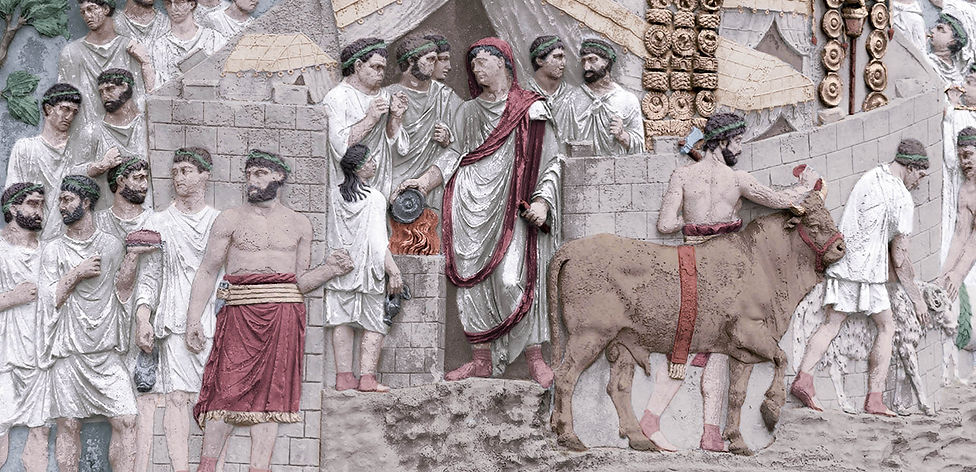
Before the army advances further into Dacia, Trajan presides over a formal military sacrifice. Priests, attendants, musicians, standards and sacrificial animals transform the Roman camp into a ritual space where religion and military command meet.
SCENE CONTEXT

Ritual Before War
Roman warfare was closely connected with religion. Before major movements or operations, sacrifices could be performed to seek divine favour, purify the army and reinforce the bond between commander, troops and gods. In this scene Trajan appears veiled during the rite, surrounded by attendants, musicians and military standards, while sacrificial animals are brought forward.
RECONSTRUCTION NOTES
Fact
The scene shows Trajan veiled in a toga during a sacrifice, accompanied by sacrificial attendants and musicians. Coulston also records a large number of unarmoured soldiers and ritual personnel around him.
Interpretation
The composition is generally understood as a major military sacrifice connected with the army’s advance. Older interpretations identify the animals as part of a suovetaurilia—the traditional sacrifice of a pig, sheep and bull—although individual details in the relief should still be treated cautiously.
Reconstruction
The reconstruction preserves the ritual hierarchy visible on the relief: Trajan as officiant, attendants handling the victims, musicians accompanying the ceremony, and military standards rising behind the enclosure. White and purple clothing, animal colours and architectural finishes are evidence-informed reconstructions rather than preserved original colours.

WHAT HAPPENS IN THIS SCENE
Trajan conducts a public sacrifice in front of the Roman camp. Sacrificial attendants prepare and lead the animals, musicians accompany the ceremony, and military standards stand prominently behind the participants. The scene presents Roman conquest not only as military action, but as an undertaking formally sanctioned through ritual.
SCENE DETAILS


1
Capite Velato — Roman Ritual Dress
Trajan performs the sacrifice capite velato, with a fold of his toga drawn over his head. This was a characteristic Roman ritual practice that visually marked the person conducting the ceremony. Here, Trajan appears not only as commander of the army, but also as the principal officiant responsible for the religious rite.
RECONSTRUCTION
Scene No.
7
REAL WORLD EXAMPLES
Male Genius of the household performing ritual with his head veiled.
.png)
Lararium of the House of the Vettii · Pompeii VI.15.1 · before AD 79 · wall painting.

2
Patera — Sacrificial Libation Bowl
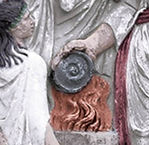
Trajan holds a shallow patera, a vessel commonly associated with Roman religious ceremonies. It could be used to pour wine or another liquid offering during sacrifice. Its prominent position in the scene reinforces Trajan’s active role in conducting the ritual rather than simply observing the ceremony.
RECONSTRUCTION
Scene No.
7
REAL WORLD EXAMPLES
Early 1st-century Roman bronze
Roman bronze patera · early 1st century AD · Metropolitan Museum of Art, New York · inv. 1989.281.87.


3
Tubicen — Roman Ritual Trumpeter
A musician accompanies the ceremony with the Roman tuba, a long, straight metal trumpet capable of producing powerful, carrying notes. Although strongly associated with military signalling, the instrument also appeared in public and religious ceremonies, connecting the ritual atmosphere of the sacrifice with the army gathered around Trajan.
RECONSTRUCTION
Scene No.
7
REAL WORLD EXAMPLES
hite-clad musicians play a long straight Roman tuba
Roman wall painting · Pompeii · 1st century AD · ceremonial scene with a tubicen.


4
Laurel Wreath — Ritual Crown
Many participants wear leafy wreaths, probably of laurel or similar sacred foliage. Such crowns were closely associated with Roman religious ceremonies, festivals and acts of sacrifice. In the scene they visually distinguish those taking part in the ritual and help transform the military gathering into a formally sacred event.
RECONSTRUCTION
Scene No.
7
REAL WORLD EXAMPLES
Laurel wreath worn around the head.
Roman wall painting, probably Pompeian fresco, showing a figure wearing a laurel wreath.


5
Roman Bread — Ritual Offering
An attendant carries what appears to be a small loaf or cake-like offering. Grain products played an important role in Roman religious practice and could accompany animal sacrifice in different forms. The relief does not preserve enough detail to identify the preparation precisely, so its exact composition remains uncertain.
RECONSTRUCTION
Scene No.
7
REAL WORLD EXAMPLES
1st-century Pompeian fresco shows several forms of Roman bread,
Fresco with the Distribution of Bread · Pompeii VII.3.30 · second half of the 1st century AD · Museo Archeologico Nazionale di Napoli, inv. 9071.