


A journey through 35000 years of rulers & civilizations

SCENE CONTEXT

Before the Invasion
Trajan’s Column begins by showing the infrastructure behind the Roman war effort. Scene I places the viewer on the Roman side of the Danube, where watchtowers, supplies and sentries prepare the frontier for the campaign. The following scenes move toward the loading of river craft and finally the army’s crossing into Dacian territory in 101 AD.
By beginning with logistics rather than battle, the monument presents Roman victory as the product of organization, engineering and preparation as much as military force.
RECONSTRUCTION NOTES
Fact
Scene I shows Roman sentries, watchtowers or fortified structures, stacked timber and haystacks along the Danube frontier.
Interpretation
Older descriptions interpret the buildings as granaries and the stores as provisions for the army; sources specifically associates them with the Drava.
Reconstruction
The reconstruction follows the structures and supplies visible on the relief, using plausible Roman frontier materials.

WHAT HAPPENS IN THIS SCENE
The opening scene of Trajan’s Column presents the Roman side of the Danube frontier before the invasion of Dacia. Small fortified buildings protected by wooden palisades stand beside carefully arranged supplies, while watchtowers secure the riverbank.
An early interpretation identifies the enclosed buildings as granaries, the rectangular stack as timber intended for fortifications, bridges, wagons and cooking, and the two conical stacks as fodder for the army’s horses and pack animals.
The scene therefore opens the campaign not with combat, but with preparation, logistics and control of the frontier.
SCENE DETAILS


1
Fortified Stores:
Small fortified compounds formed part of the Roman frontier system, combining timber palisades, defensive ditches and internal buildings. Comparable fortlets in Roman Dacia controlled roads and passes, housed small detachments and could also protect supplies moving through the frontier zone. The reconstructed fortlet at Pohl provides a close visual parallel for a compact Roman earth-and-timber frontier compound around AD 100.
RECONSTRUCTION
Scene No.
1
REAL WORLD EXAMPLES
Reconstructed Roman timber-and-earth fortlet.
.png)
Limeskastell Pohl · Germania Superior · c. AD 100 · Reconstruction based on archaeological evidence.


2
Timber Stockpile
Timber was essential to Roman military logistics, serving in the construction of palisades, bridges, buildings, wagons and other camp infrastructure. Wood was also required as fuel, making organised stockpiles an important resource along an active military frontier.
RECONSTRUCTION
Scene No.
1
REAL WORLD EXAMPLES
-
-

3
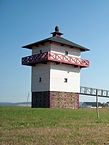
Frontier Watchtowers
Roman watchtowers formed part of a coordinated frontier surveillance system. Positioned along roads, rivers and strategic high points, they allowed small detachments to observe movement, guard crossings and relay warnings between nearby military posts. Watchtowers helped Roman troops monitor the frontier and communicate rapidly between military posts.
RECONSTRUCTION
Scene No.
1
REAL WORLD EXAMPLES
Reconstructed frontier watchtower at Pohl
Limeskastell Pohl · Upper Germanic-Raetian Limes · c. AD 100 · Reconstruction based on archaeological research.


4
Signal Torches
Fire signals allowed Roman frontier posts to communicate warnings over distance, particularly at night. The torches shown projecting from the towers in Scene I are generally interpreted as signalling devices.
RECONSTRUCTION
Scene No.
1
REAL WORLD EXAMPLES
-
-